
Srinagar, May 16, 2026: The Chief Minister Omar Abdullah-led Council of Ministers has recently accorded approval to major projects aimed at strengthening solid waste and used-water management systems in both the divisions of Jammu and Kashmir.

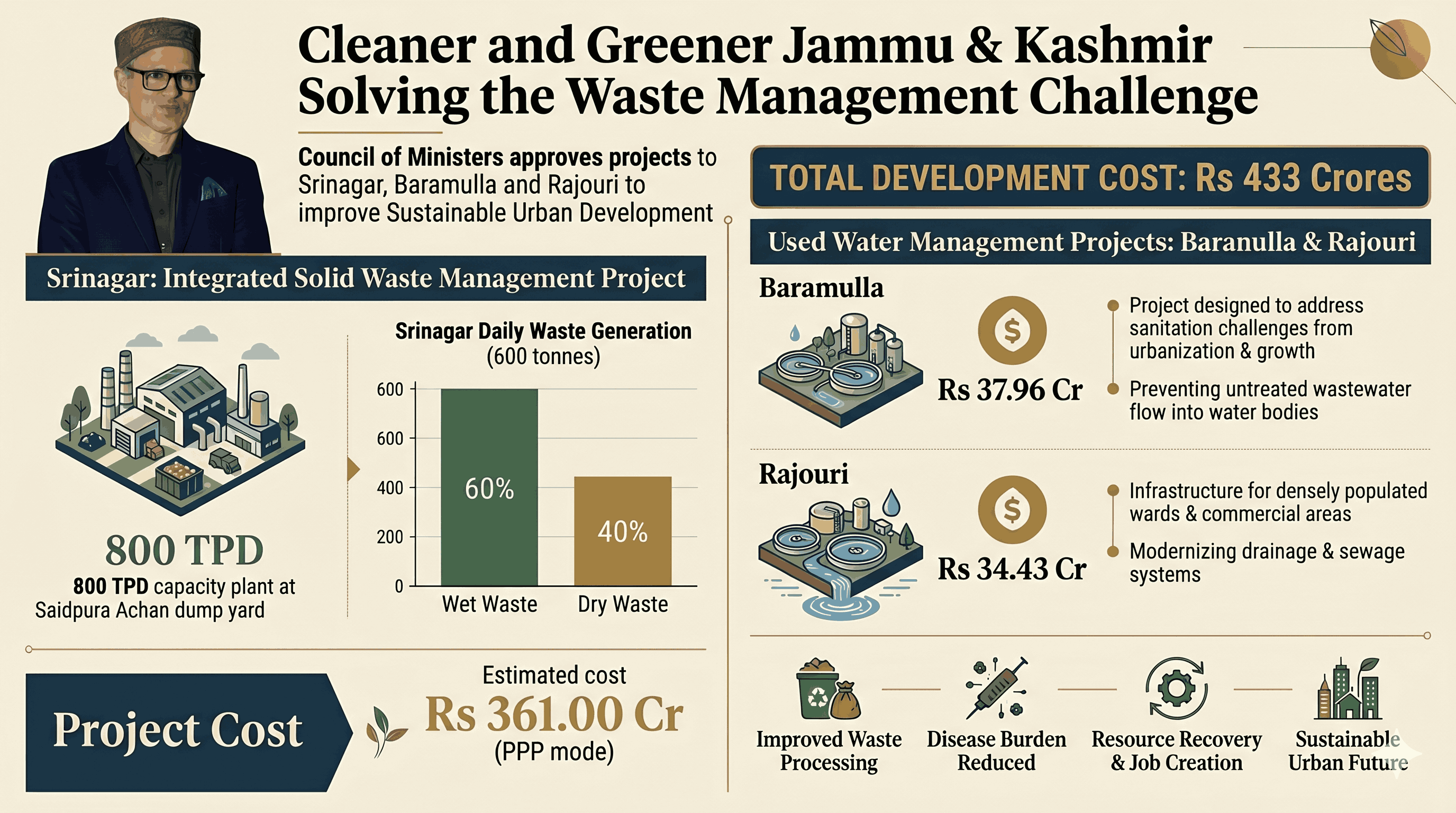
Built at a combined Cost of nearly Rs 433 crores, these projects are proposed to be set up in Srinagar, Baramulla and Rajouri. These projects are expected to signifi cantly improve sanitation, protect public health and promote sustainable urban development.
The largest of these projects is the establishment of an 800 Tonnes Per Day (TPD) Integrated Solid Waste Management (ISWM) Project in Srinagar at the Saidpura Achan dump yard, to be implemented through Public-Private Partnership mode at an estimated cost of Rs. 361.00 crore.
The project has been conceived to address the growing challenge of municipal solid waste in Srinagar, where estimates indicate around 600 tonnes of waste are generated daily, comprising nearly 60 per cent wet waste and 40 per cent dry waste. While the Srinagar Municipal Corporation has systems for source segregation, door-to-door collection and transportation, there is a need to improve scientifi c processing and disposal.
The plant capacity has been planned at 800 TPD, keeping in view present and future requirements of the city. The project is expected to help reduce open dumping, foul smells, pest infestation, drainage choking and other environmental and health hazards.
Additionally, the Council of Ministers has also accorded Administrative Approval for the Used Water Management Project in Municipal Council
Baramulla at an estimated cost of Rs 37.96 crore. The population of Baramulla continues to grow due to urbanisation, trade, and institutional development. However, this growth has put increasing pressure on civic infrastructure, particularly sewerage and sanitation systems. The present project is designed to address this public challenge.
Similarly, Administrative Approval has been granted for the Used Water Management Project in Municipal Council Rajouri at an estimated cost of Rs 34.43 crore.
Over the years, the town has witnessed rapid urban growth, largely driven by its educational base, trade activity, and administrative role. However, this growth has created signifi cant pressure on existing water supply, drainage, waste management, and sanitation infrastructure, particularly in densely populated wards and commercial areas.
The Rajouri project, like the one in Baramulla, will include interception and diversion of wastewater, sewage pumping stations, a sewage treatment plant and septage treatment facility, using advanced technology.
These projects are expected to bring multiple long-term benefi ts to the people of Jammu and Kashmir. The Srinagar solid waste project will help improve waste collection, segregation, treatment and scientifi c disposal, thereby reducing open dumping, pollution and public health risks. It will also support better urban planning and sustainable waste handling in view of the city’s future growth.
The Baramulla and Rajouri used-water management projects will help prevent untreated wastewater from fl owing into drains, rivers and other water bodies, thereby reducing water pollution and safeguarding public health. These projects will also contribute to cleaner surroundings, improved sanitation, reduced disease burden and better quality of life for residents.
In addition, the initiatives are expected to strengthen environmental protection, promote resource recovery, generate employment opportunities and improve the overall liveability of these cities and towns. For the government, these projects represent a fulfi lment of the promise of citizen-centric and responsive governance.